Progress on HS2’s Curzon Street station as new images are released
Engineers working for the HS2 project completed the last of more than 2,000 concrete piles that will underpin the foundations of Birmingham's Curzon Street station this week, as new images were published showing how the public spaces around the building will look.
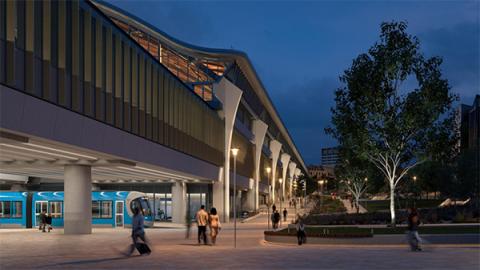
Stretching for more than 400m between Moor Street station and Millennium Point, Curzon Street will include seven platforms covered by an enormous arched roof inspired by the railway architecture of the Victorian age.
Construction of the new station is now well underway, with engineers this week completing the last of 2,011 piles. These concrete columns - each between 6 and 24 metres deep – have been sunk into the ground to support the foundations of the building.
HS2 Ltd’s Senior Project Manager, Alistair Morgan said: “Once complete, Curzon Street will be a new landmark for Birmingham - and provide a fitting city centre terminus for a railway that will improve journeys and free up space on the existing West Coast Main Line. These new images also show how it will be integrated into the rest of the city – with new green spaces, better accessibility and onward public transport links. It’s great to see how much progress has been made on the foundation works and I’d like to thank everyone who’s been working so hard to get the job done. But we’ve still got a lot of work to do before the first passengers arrive, and I look forward to seeing more significant progress in the year ahead.”
At the front of the station, passengers will pass through a paved ‘station square’ edged by gardens facing Moor Street Queensway.
The new images released today show recent landscape design refinements that are being submitted to Birmingham City Council for approval. These include improvements to the management of rainwater drainage and improvements to the integration of cycling and walking routes connecting to the wider city.
They also show the tree-lined promenade with landscaped terraces that will stretch along the side of the building. A second entrance at the other end of the station - giving access to Digbeth and the east side of the city - will include a tram stop and taxi drop-off points as well as improved cycle access.
Next to the eastern entrance, a new square will face the disused Old Curzon Street station building which was built in 1838. A new terrace and gardens will be created to the rear of the old station to complement the setting of the historic building.
The piling work, which began in Sept 2024, was delivered by HS2’s construction partner Mace Dragados joint venture (MDJV), working with Keltbray. As part of the project, the team installed an 8m high retaining wall at the western end of the site and excavated 47,000 cubic metres of material to create a level base for the station.
Once the earthworks were complete, they brought in CFA piling rigs to install the reinforced concrete piles.
MDJV’s Senior Project Manager, Rodger Storey, said: “Completing the foundation works for Curzon Street station marks a major milestone in the delivery of the project. The team is proud of the major achievement represented the extensive piling operation that forms the station’s foundations. “With this crucial phase now finished, we look forward to progressing the construction of the station building itself, which will create further jobs, apprenticeships, and supply chain opportunities as activity on site continues to ramp up.”
Following a short pause to allow Network Rail to deliver some essential maintenance to the railway viaduct alongside the site, the final piles were installed during late February and early March 2026.
With the piling now complete, the main focus has turned to preparing the way for the Digbeth extension to the West Midlands Metro - which will stop under the station on New Canal Street – and completion of the remaining foundation works.
In total, more than 19,000 tonnes of reinforced steel and 69,000 cubic metres of concrete are needed for the sub-surface work, with 7,000 tonnes of reinforcement already installed and 29,000 cubic metres of concrete poured.
Elsewhere on the site, progress is also being made on the temporary office block that will be the nerve centre for the next stage of construction. At the peak of the work, more than a thousand people are expected to be employed on the Curzon Street project, both directly and via Mace Dragados’s UK supply chain.
Progress is also being made on the viaducts that will carry HS2 services into the city centre, with the massive Curzon 2 viaduct almost complete. This 40-metre-high structure – the tallest on the project – will be slid into place across the Cross City line in the summer.
These structures are being built by another of HS2’s contractors, Balfour Beatty VINCI. In total, more than 33,000 jobs are supported by the construction of HS2, with the project recently celebrating the appointment of its 2,000th apprentice, a 19-year-old from Bordesley Green in Birmingham.
However, there is still significant work to do across the whole 140 miles between London and Birmingham. Mark Wild, HS2 Ltd Chief Executive, is now leading a comprehensive reset of the project to ensure the remainder of the route is delivered as efficiently as possible and for the lowest reasonable cost.